16 Cozy Bedroom Aesthetic Ideas That Feel Like a 5-Star Hotel
Cozy Bedroom Aesthetic Ideas:
You know that feeling when you walk into a luxury hotel room and instantly exhale? Your shoulders drop. Your mind quiets. You think, “Why can’t my bedroom feel like this?”
For most people, their bedroom feels like a storage unit that happens to have a bed. Clashing colors. Bad overhead lights. Cheap pillows. Clutter everywhere. No wonder you don’t sleep well.
Hotels spend millions figuring out what makes a room feel calm and cozy. The good news? You don’t need millions. You don’t even need a renovation.
This guide gives you 16 specific ideas from 5-star hotels like Four Seasons, Aman, and Rosewood. Every idea works for 2026 trends. Every idea costs less than $200 (most cost under $50). And every idea helps you sleep better tonight.
Let’s get your bedroom to feel better than any hotel.
1. Layer Your Lighting Like a Hotel Designer
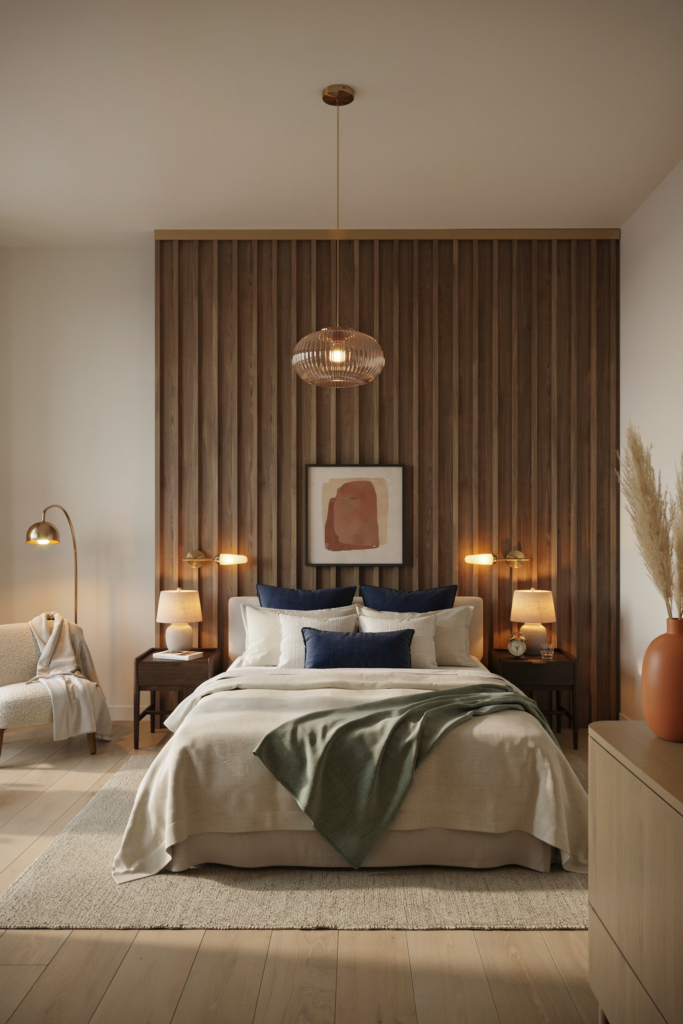
Remember checking into a hotel and realizing the light feels warm? Not harsh. Never harsh. That’s not luck. That’s design.
Most homes have one overhead light. That’s a migraine machine. It casts shadows. It feels like an interrogation room. Hotels never do this.
Instead, they use three layers of light. First, ambient light. That’s your ceiling fixture, but with warm bulbs (2700K to 3000K). Second, task light. Reading sconces or a small lamp on your nightstand. Third, accent light. A floor lamp in the corner or a picture light above art.
The magic trick is dimmers. A study in the Journal of Environmental Psychology found that dimmable warm light lowers cortisol by about 25 percent before sleep. Less stress chemicals mean faster sleep.
Four Seasons rooms never have more than three visible light sources. That’s the rule. Pick three. Ditch the rest.
needed.
2. Pick the Quiet Color Palette for 2026
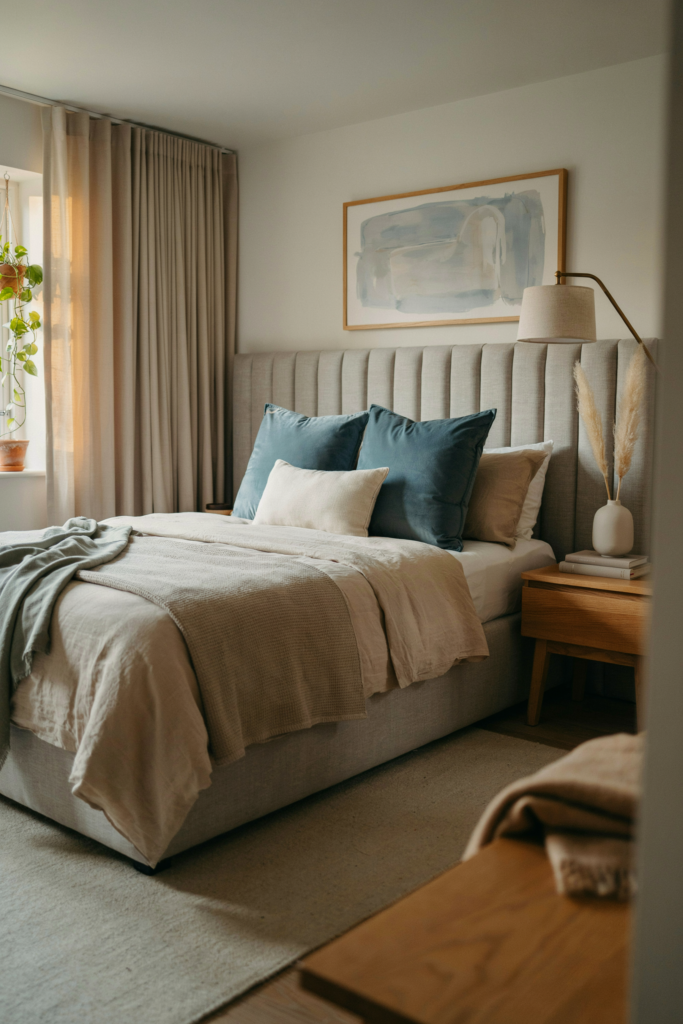
White walls feel cold. Gray walls feel like a dentist office. Hotels know this, so they use warm, soft colors instead.
For 2026, three colors dominate cozy bedrooms. Adobe White is a warm off-white that feels like sun on plaster. Slate Mousse is a brown-gray that reads as “stone” not “sad.” Eclipse Blue is deep but soft, like the sky 10 minutes after sunset.
Rosewood hotels use seven to eight shades of beige in one room. That sounds excessive. But it works because beige has warmth. Pure white has none.
Benjamin Moore’s 2026 Color of the Year is Cinnamon Slate. It’s a warm greige. Sherwin-Williams picked Quietude, a soft sage-green. Both work perfectly for a hotel bedroom.
Here’s the formula. Use 60 percent main color (walls). Use 30 percent secondary color (bedding or rug). Use 10 percent accent color (pillows or art).
3. Build a 5-Star Bed Layering System
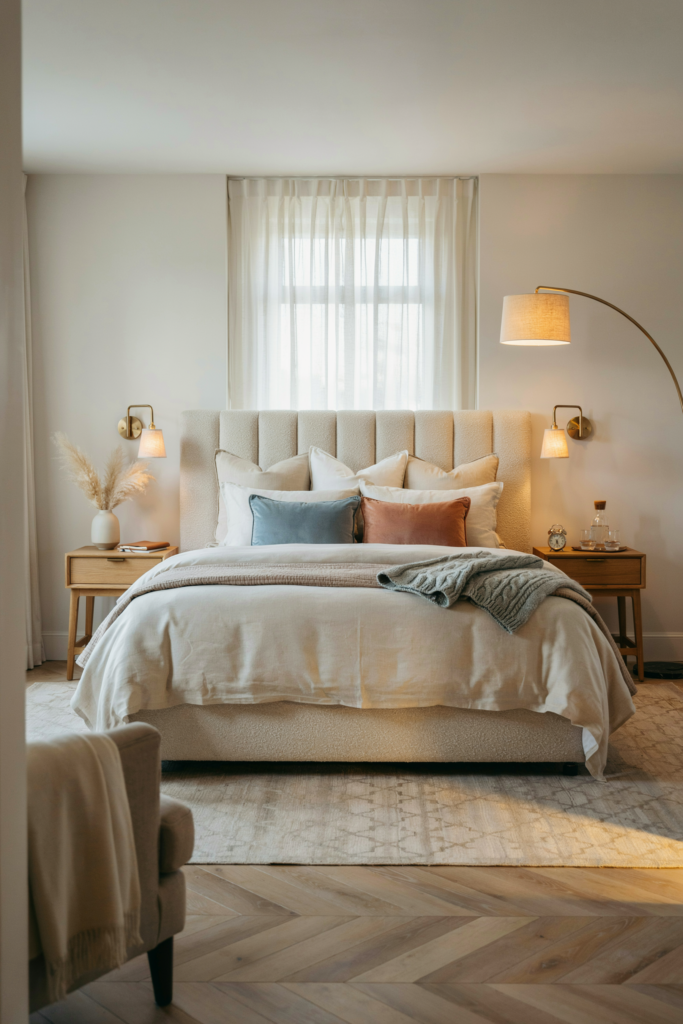
Hotels don’t have just a sheet and a comforter. They have a system. And guests rate bed layering as the number one factor in feeling cozy, according to Marriott’s guest surveys from 2024 to 2025.
Here’s the full hotel stack from bottom to top. Mattress. Mattress protector (waterproof but quiet). Fitted sheet. Flat sheet. Duvet with insert. A folded blanket at the foot of the bed. Two to four pillows per person.
For sheets, use cotton percale if you want crisp and cool. Use linen if you want relaxed and textured. Never use microfiber. It traps heat and feels cheap.
Weighted blankets are out for 2026. Pinterest data shows searches dropped 40 percent. What’s in? Layered lightweight blankets. A cotton quilt plus a wool throw. You can adjust warmth by adding or removing one layer.
The visual trick is the blanket at the foot. It adds weight to the bottom of the bed. Without it, the bed looks unfinished.
4. Hide Everything. That’s the Rule.
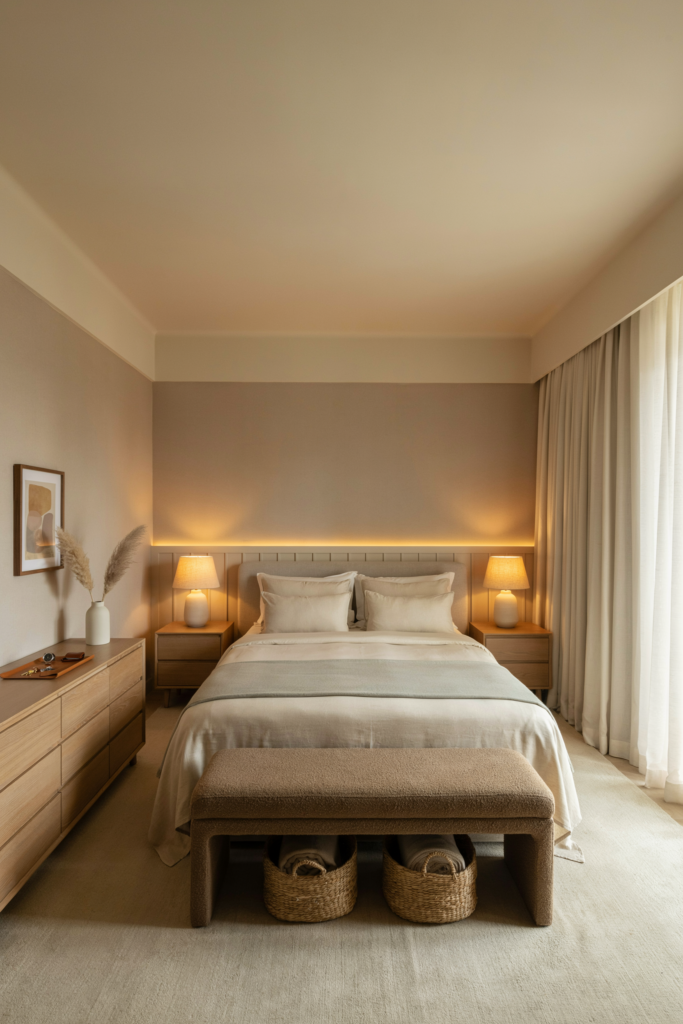
Walk into any 5-star hotel room. Where’s the clutter? There isn’t any. No phone cords. No mail piles. No random water bottles.
Hotels call this “visual silence.” And you can steal it for almost no money.
First, get a valet tray. 1 Hotels uses leather trays on dressers. You dump your keys, wallet, and watch in the tray. It looks intentional, not messy. A bamboo or cork tray costs $15 on Amazon.
Second, close your storage. Nightstands with drawers hide chargers and books. Baskets under a bench hide extra blankets. If you see it, it’s noise.
Third, hide the cords. Run charging cables behind your nightstand. Use a cable sleeve from IKEA ($5). Or drill a small hole in the back of your nightstand drawer. Charge your phone inside the drawer.
Here’s the hotel secret. The room should look ready for a photo shoot at all times. Not perfectly clean. Just visually quiet.
5. Your Headboard Is Too Short. Probably.
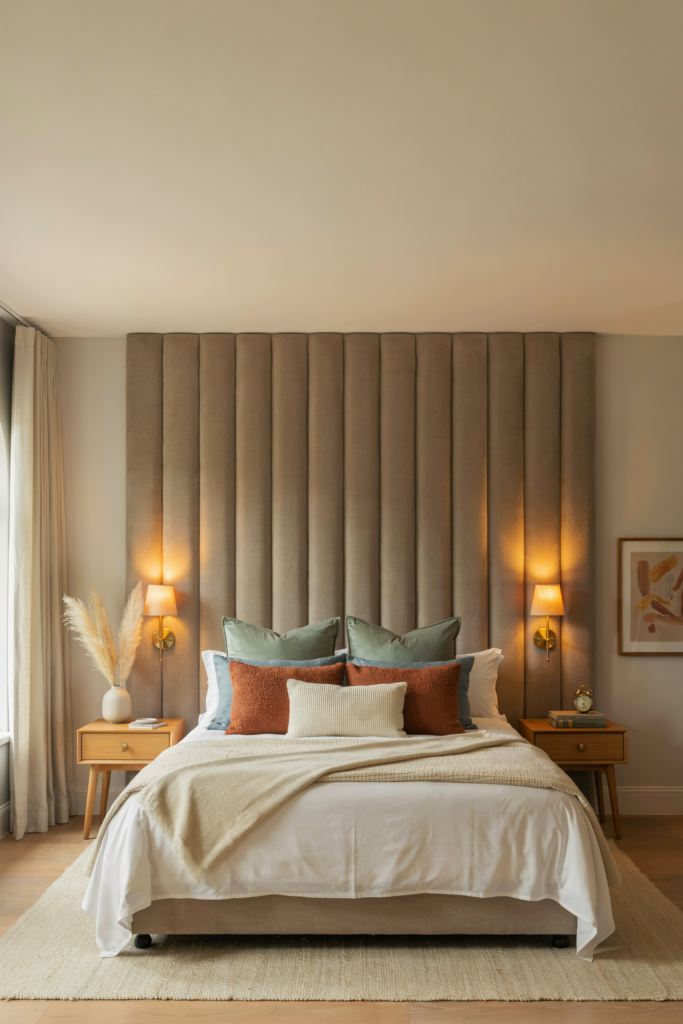
Low headboards signal temporary lodging. Motels have low headboards. Dorms have low headboards. Five-star hotels have tall, soft headboards.
Hotel standard is 48 inches minimum from the floor to the top of the headboard. That’s about chin height when you sit on the bed. Some go to 60 inches.
The material matters more than you think. Upholstered linen or velvet feels expensive and soft. Cane webbing adds texture without weight. Metal or wood-only headboards look cold. Hotels avoid them.
If you can’t buy a new headboard, here’s a cheap fix. Hang a quilt or a flatweave blanket on the wall behind your bed. Attach it to a curtain rod. Instant soft headboard for under $50.
Hospitality Design magazine quoted designer Alexandra Z. in March 2025. She said, “A low headboard signals temporary lodging. High, soft headboards signal permanence and safety.” Your bedroom should feel permanent.
6. Add Nature, But Keep It Quiet
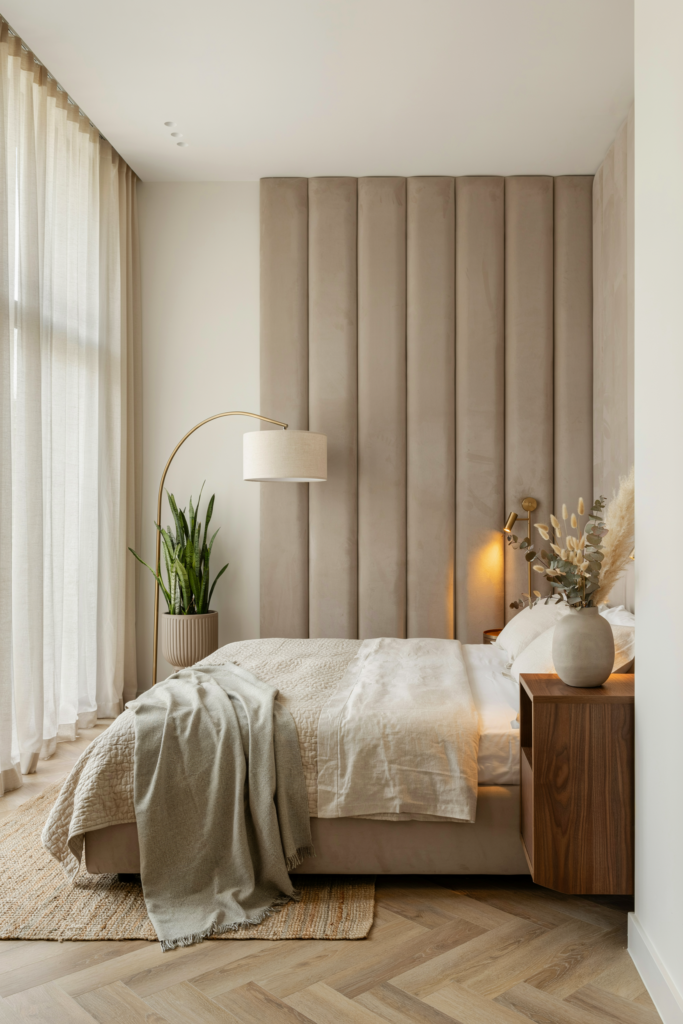
Hotels don’t put busy flower arrangements in bedrooms. They use one large plant and a few dried stems. That’s it.
For 2026, the trend is “quiet biophilic.” That means nature that doesn’t scream for attention.
Get one large low-light plant. Snake plants and ZZ plants are impossible to kill. They clean air. They add green without being loud. A medium snake plant costs $20 at Home Depot.
Add dried botanicals. Eucalyptus, pampas grass, or bunny tails. They last for years. No watering. No bugs. A bunch of dried eucalyptus costs $10 at Trader Joe’s or online.
Avoid fake plants. Hotels never use them. They collect dust and look sad. Avoid busy florals too. A big bouquet of bright flowers belongs in a lobby, not a bedroom.
The Human Spaces report from 2025 found that bedrooms with one or two organic elements reduce self-reported anxiety by 18 percent. That’s a meaningful drop for almost no work.
7. Use the Hotel Bath Towel Rule for Rugs
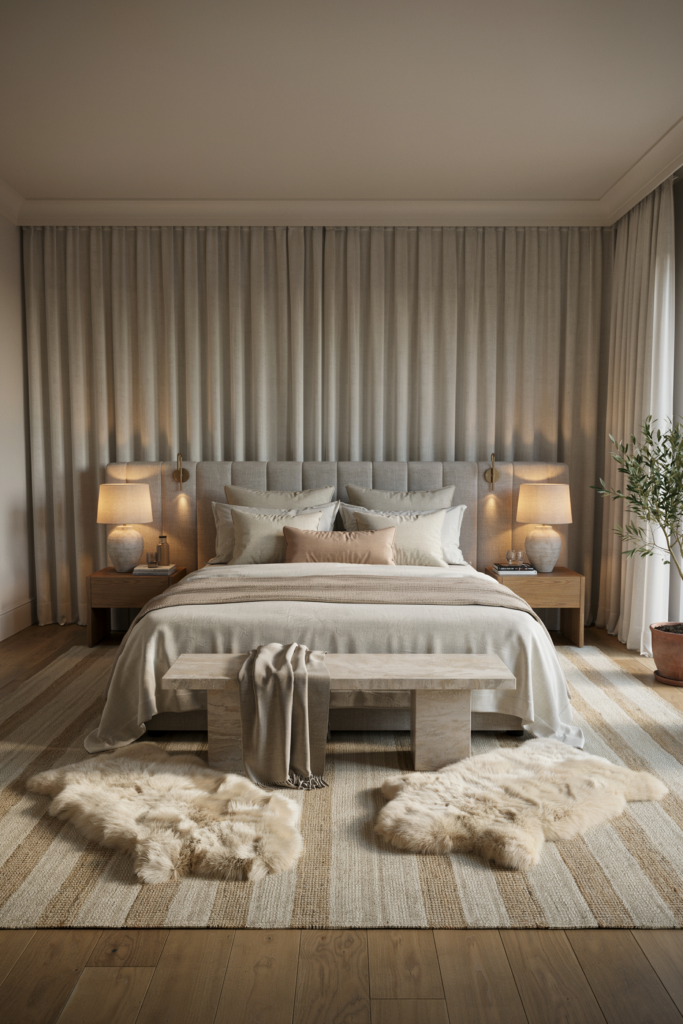
Hotels use thick, fluffy bath towels because texture signals luxury. The same rule applies to bedroom rugs.
You need two rugs. First, a large natural fiber rug under the bed. Jute or wool. It should extend 24 inches beyond each side of the bed. That means if you have a queen bed (60 inches wide), your rug should be at least 108 inches wide.
Second, a small soft rug on each side of the bed. Sheepskin or a thick cotton shag. Your feet land on something plush when you wake up.
The Ned hotel in London uses 100 percent wool flatweave rugs in every room. Wool is durable, soft, and naturally stain resistant. Synthetic rugs feel cheap. Hotels avoid them.
Here’s the test. Run your hand over your current rug. Does it feel good? If not, replace it. A bedroom rug should make you want to sit on the floor.
8. Double Your Curtains. Always.
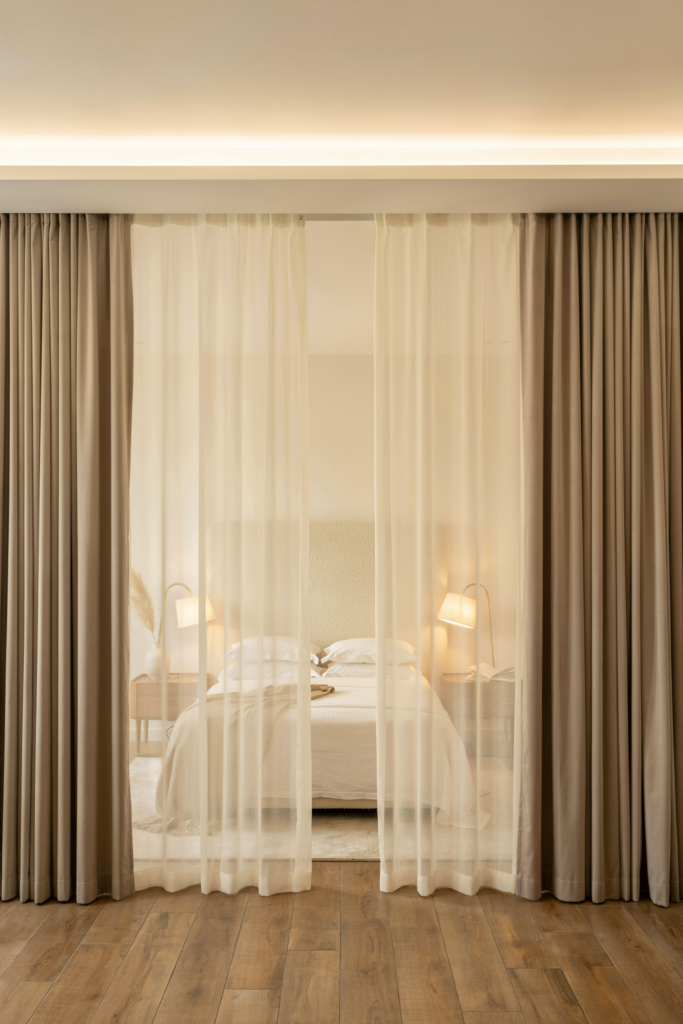
Hotels never have just one set of curtains. They have two. A blackout layer and a sheer layer.
Blackout curtains block light and noise. The Sleep Foundation published a 2026 meta-analysis showing that blackout curtains reduce sleep onset time by 30 percent in urban bedrooms. That means you fall asleep faster by almost 10 minutes.
Sheer curtains soften the window. They diffuse daylight. They make the room look bigger.
Install a ceiling-mounted track for full coverage. It hides the hardware and lets curtains close completely without gaps. Amazon sells basic tracks for $30.
Curtains must touch the floor. Puddle them one to two inches. Short curtains look like you gave up. Hotels never give up.
9. Pick a Signature Scent. No Candles.
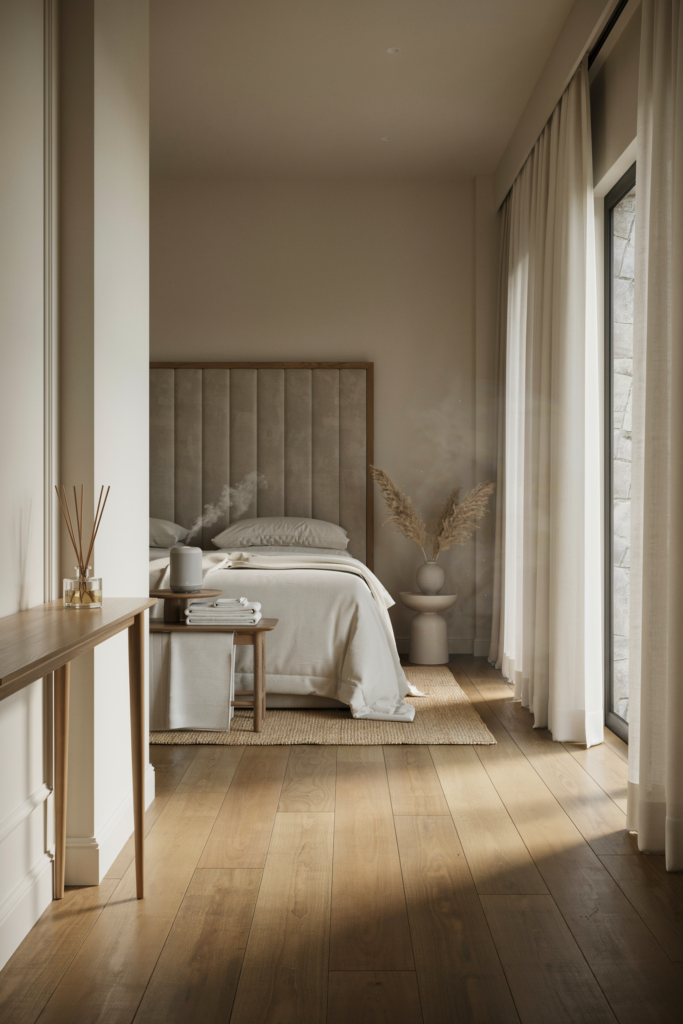
Hotels smell good on purpose. But they almost never use candles. Open flames are a fire risk. And candles create soot on walls.
Instead, hotels use reed diffusers or ultrasonic diffusers. Reed diffusers are silent. Ultrasonic diffusers add a little humidity, which helps with dry winter air.
For 2026, the top hotel scents are hinoki wood (woody and clean), cardamom (spicy but soft), cotton linen (fresh without being soapy), and rain (earthy and calm).
Westin Hotels refreshed all their rooms in 2025 with white tea scent diffusers. You can buy the exact oil online for $18.
Put the diffuser near your bedroom door, not on your nightstand. You want the scent to hit you when you enter, not overwhelm you while you sleep.
10. Hang One Big Art Piece. Not a Gallery Wall.
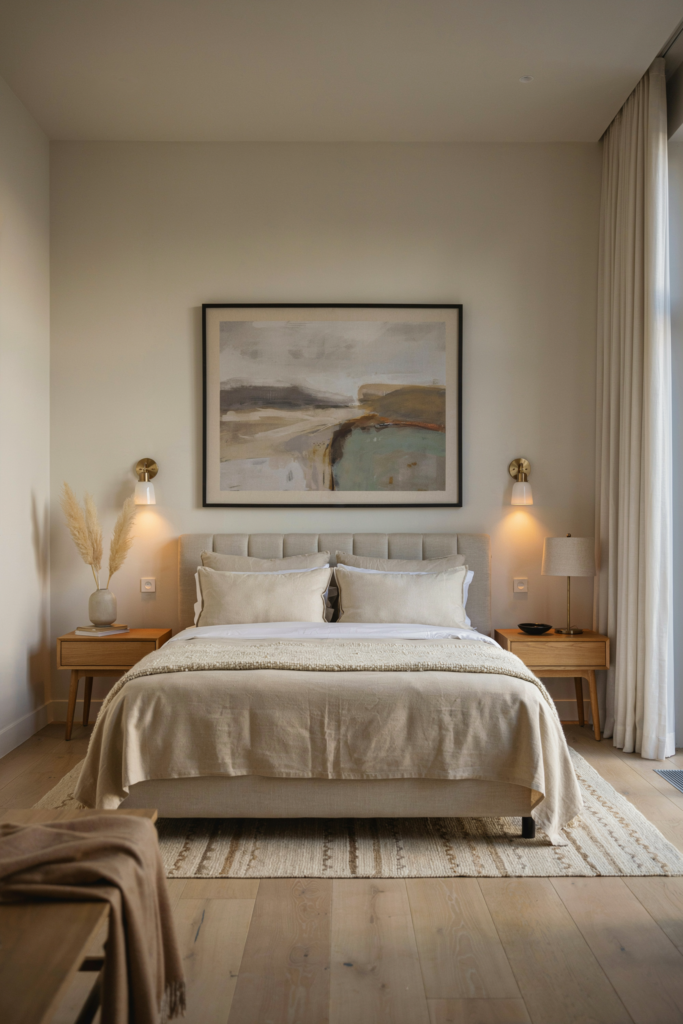
Gallery walls are for hallways and coffee shops. They create visual noise. Your bedroom needs one quiet place for your eye to rest.
Hotels hang one large art piece per bedroom. Abstract or landscape. Nothing busy. Nothing with words.
The piece should be at least 48 inches wide. That’s wider than most people think. A small frame looks lost on a big wall.
Frame it with matting and museum glass. Museum glass has no reflection. You won’t see yourself or the window in the art. Framing costs more than the art sometimes, but it’s worth it.
Hang the center of the art at 60 inches from the floor. That’s average eye level. Most people hang art too high.
Forbes quoted hospitality designer Kati Curtis in 2025. She said, “Gallery walls create visual noise. One quiet piece creates a resting place for the eye.” Your bedroom needs resting places.
11. Run Curtains From Ceiling to Floor
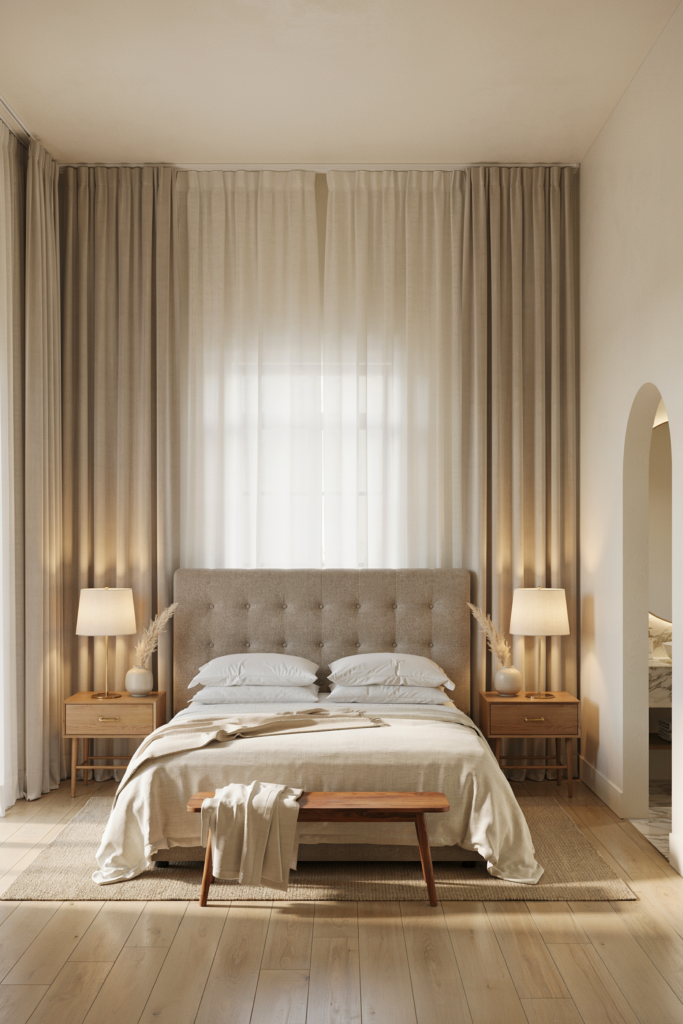
Short windows look awkward. Hotels fix this by hanging curtains from the ceiling, not from the window frame.
Install your curtain rod one inch below the ceiling. Let the curtains drop all the way to the floor. This tricks your eye into thinking the window is taller.
Even if your window is only three feet tall, floor-length curtains make the room feel grand. It’s a cheap illusion. A $30 rod and $40 curtains can change the whole room.
12. Use Two Nightstands. Always.
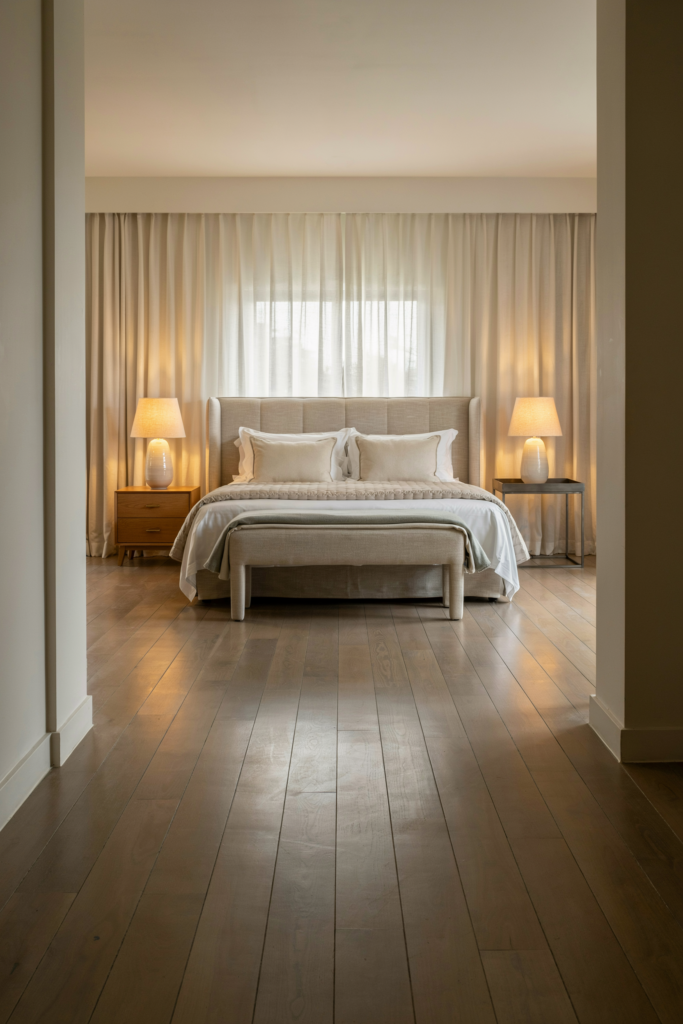
Symmetry signals calm. One nightstand says “temporary.” Two nightstands say “permanent.”
They don’t have to match perfectly. But they should be the same height and similar visual weight. A wooden nightstand on one side and a metal stool on the other side works fine.
Each nightstand needs one thing. A lamp. That’s it. No clutter. No piles of books.
13. Hide Your Phone. Put It on Silent.
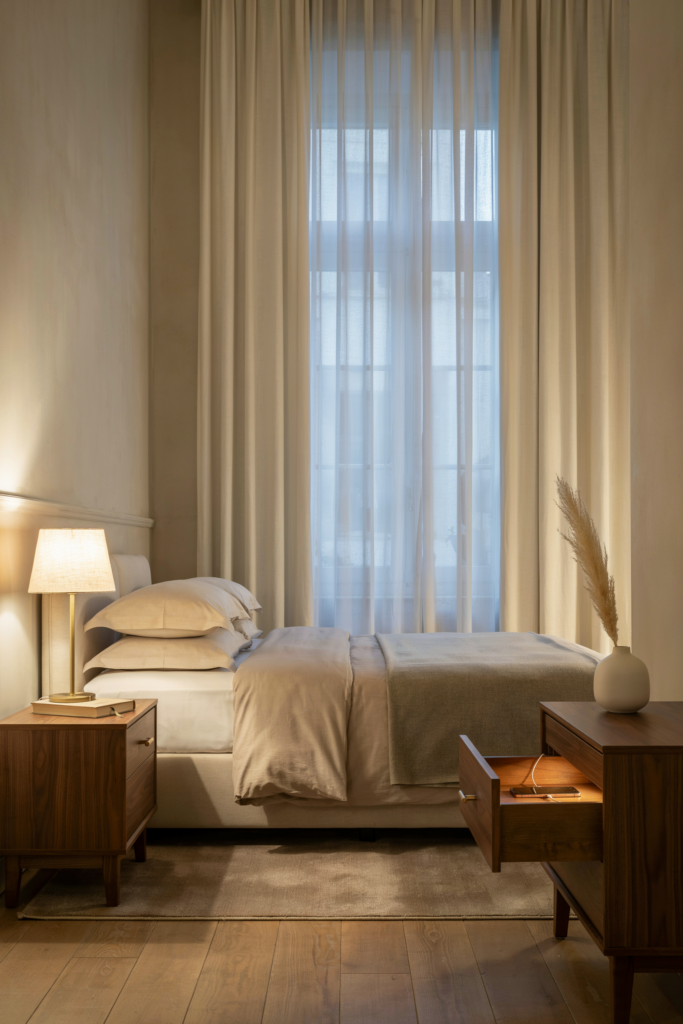
Hotels don’t have buzzing phones on nightstands. Neither should you.
Charge your phone inside a drawer. Or across the room. The blue light and notifications wreck your sleep even if you don’t wake up fully.
Set your phone to silent. Not vibrate. Silent. Vibrate creates low-frequency noise that your brain processes even when you’re asleep.
14. Build a Hotel Corner
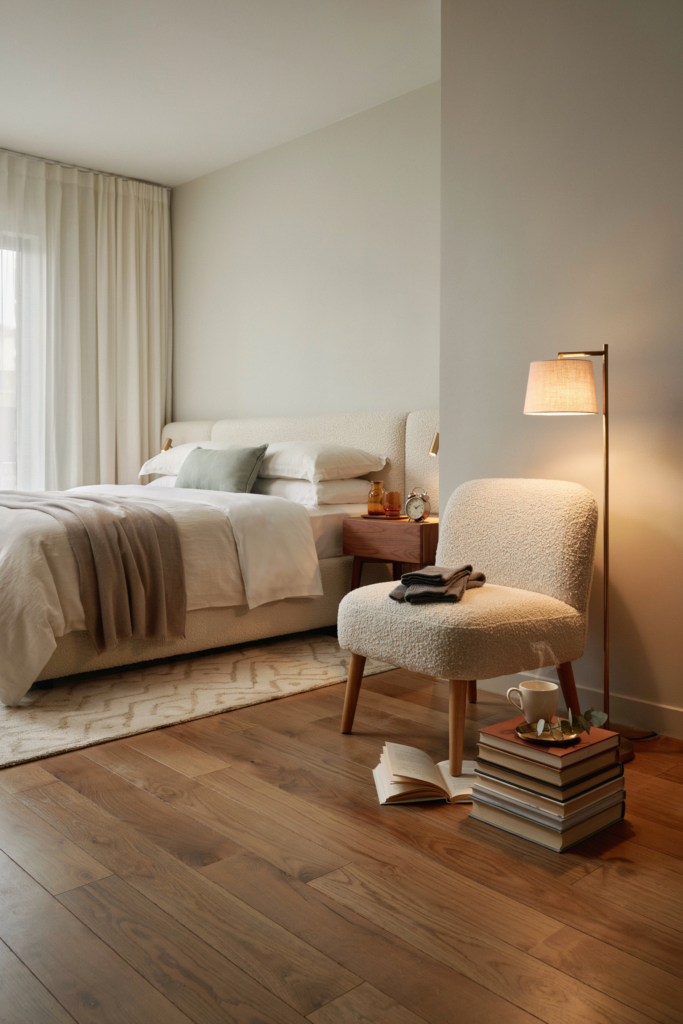
Hotels always have a small seating area. One armchair. One floor lamp. One tiny side table.
This corner says “stay awhile.” It gives you a place to put on socks, read for five minutes, or just sit and breathe.
You don’t need a big room. A 24-inch wide chair fits in most bedrooms. Push it into a corner. Add a $20 floor lamp from IKEA. Use a stack of books as a side table.
15. Iron Your Pillowcases. Yes, Really.
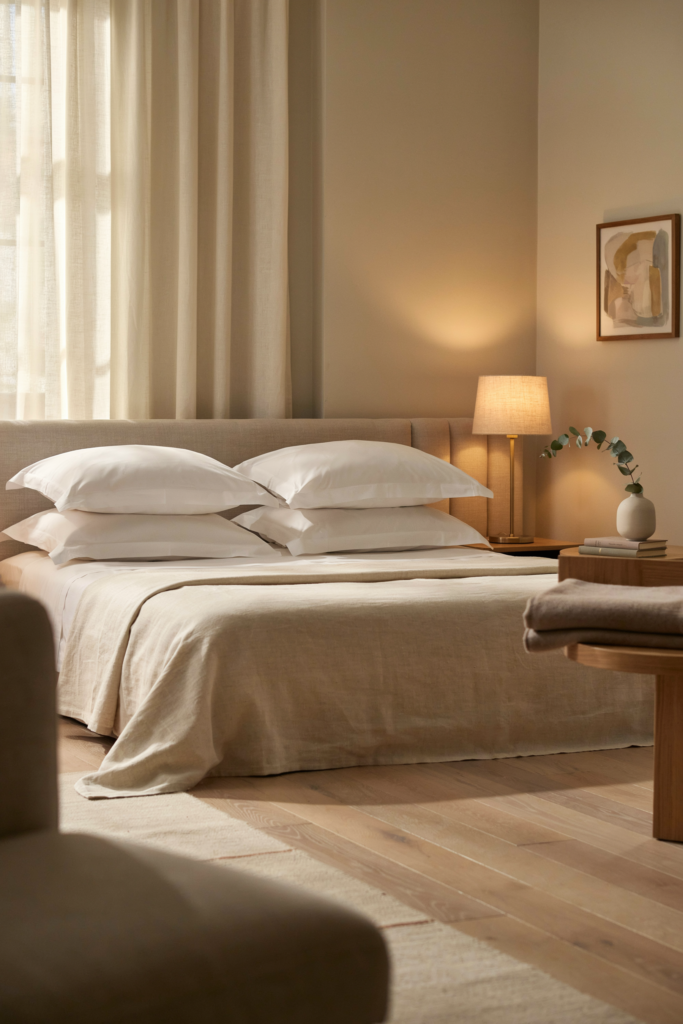
Hotels press their pillowcases and flat sheets. It’s not about being fancy. Wrinkled fabric feels slept-in. Crisp fabric feels fresh.
You don’t need a dry cleaner. Just iron the top third of your pillowcases and the top edge of your flat sheet. That’s the part you see and touch.
Linen stays wrinkled. That’s fine. But cotton percale should look sharp. A five-minute iron once a week changes the whole feel of the bed.
16. Do a 5-Minute Turndown Service Every Night
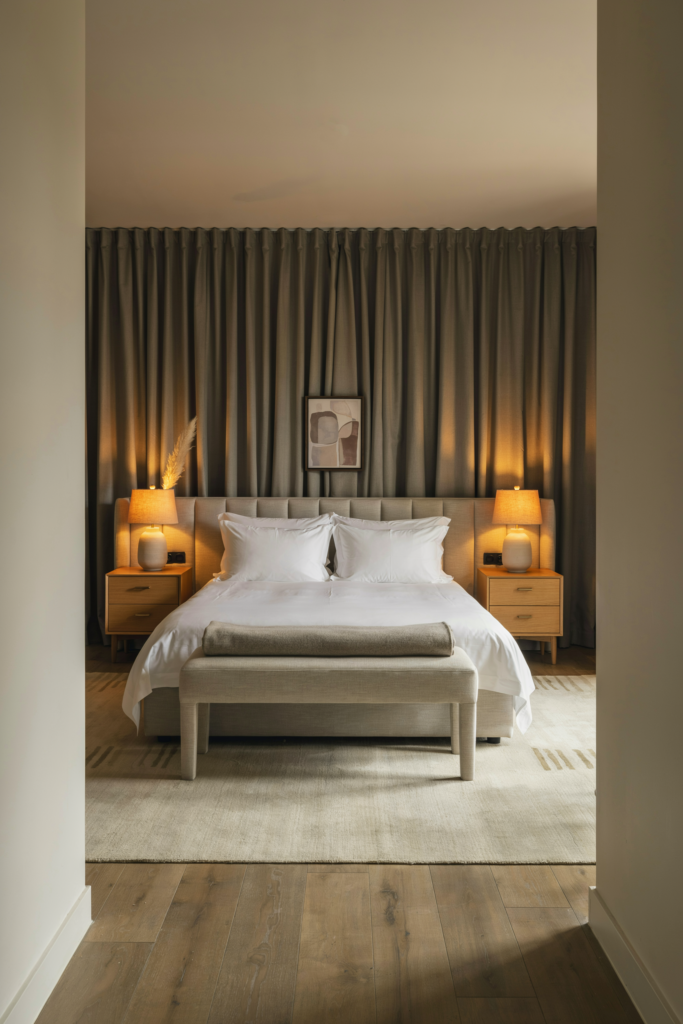
Hotels don’t leave your room messy. They reset it every evening. You can do the same in five minutes.
Here’s the routine. First, fold your throw blanket at the foot of the bed. Second, fluff and arrange your pillows. Third, dim your lights to their warmest setting. Fourth, close your blackout curtains. Fifth, put everything on your nightstand into the drawer.
That’s it. Five minutes. The room goes from “day mode” to “sleep mode.”
Conclusion
A cozy bedroom is not about buying expensive furniture or copying every trend you see online. The rooms that feel most relaxing often follow a few simple principles. Soft lighting, comfortable layers, calming colors, and less visual clutter.
That is exactly why luxury hotels feel so good. Every detail is designed to help you slow down, relax, and sleep better.
The good news is that you do not need a renovation to create the same feeling at home. Even one small change can make a noticeable difference. A pair of blackout curtains. A taller headboard. A bedside lamp with warm light. A simple evening turndown routine.
Start with the ideas that fit your space and budget. Focus on comfort instead of perfection. As you add these hotel-inspired touches, your bedroom will begin to feel calmer, warmer, and more welcoming every day.
The best bedroom aesthetic for 2026 is not the most expensive one. It is the one that helps you rest, recharge, and feel at peace the moment you walk through the door. Your own personal 5-star retreat is closer than you think.